The Manufacturability Blind Spot: Why CAD Still Can't See the Factory Floor
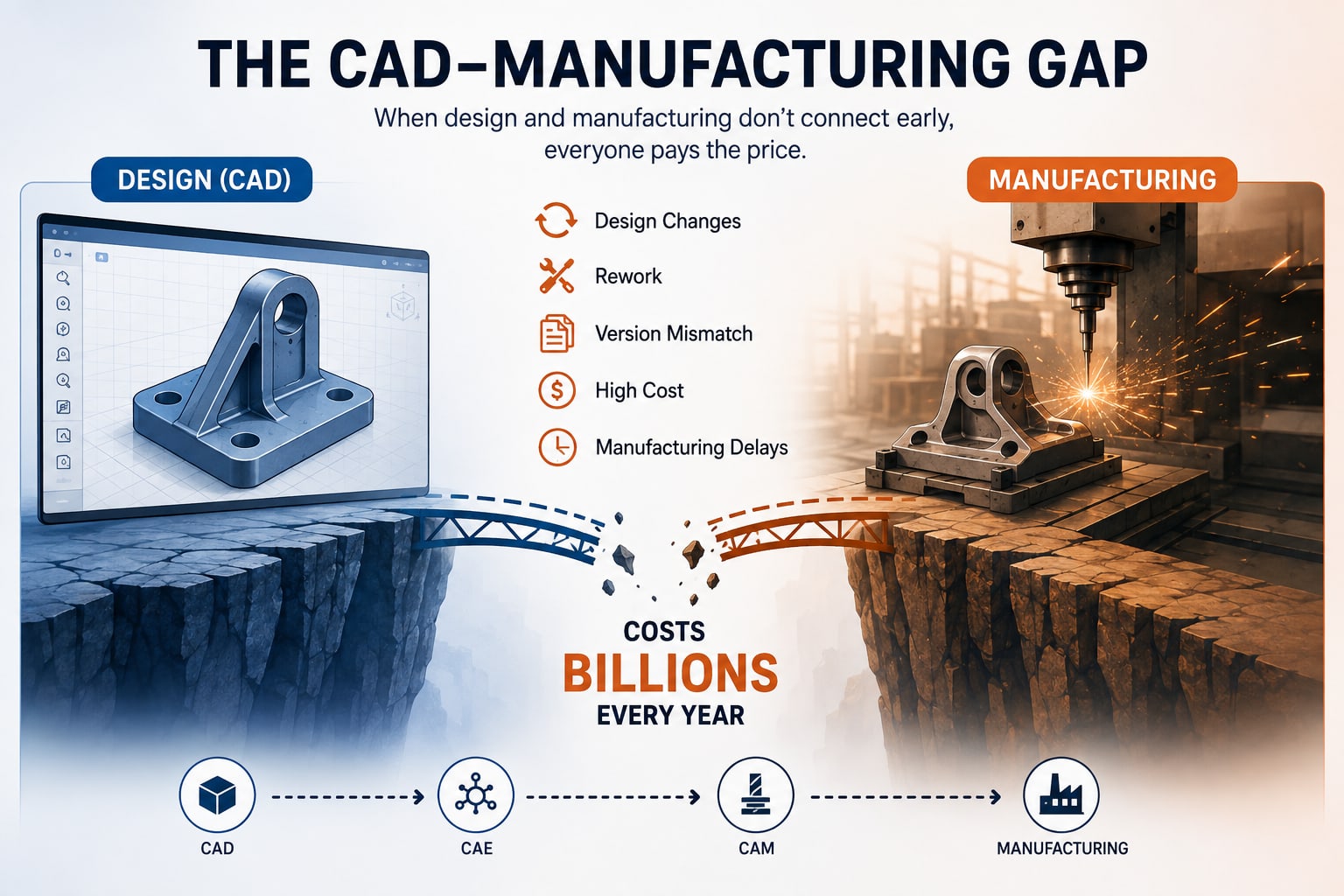
Modern CAD can model an entire aircraft assembly. It still can't tell you whether the bracket you just designed is a nightmare to machine — and that single blind spot costs manufacturers billions every year.
The Digital Thread Is Still Broken
Most engineering teams run the product lifecycle across a chain of disconnected tools. Design in CAD. Export files. Prepare manufacturing drawings. Convert models for simulation. Generate CAM toolpaths. Review with manufacturing. Revise the design. Repeat.
Every handoff in that chain introduces friction. Each exported file is another version to track. Every software boundary is another place for information to quietly disappear. Every engineering change forces a cascade of downstream updates that someone has to remember to make. What should be a continuous workflow becomes a relay race where the baton gets dropped at every exchange.
Design Intent Gets Lost in the Handoff
A CAD model holds far more than geometry. It carries dimensions, constraints, relationships, material assumptions, and the reasoning behind every decision the designer made. When that model moves to the next tool in the chain, most of that reasoning doesn't survive the trip.
Manufacturing engineers typically inherit static geometry and a drawing, then spend real time reconstructing the intent that should have travelled with the file. The result is a constant background hum of questions that shouldn't need asking:
"What tolerance should this feature actually hold?"
"Can this internal corner take a larger radius?"
"Was this hole sized for machining or for casting?"
"Is this surface cosmetic, or does it do something structural?"
Multiply that by every part, every program, every week, across every manufacturing organisation, and none of those conversations are building a better product. They're just recovering information that already existed and got left behind.
Late Manufacturing Feedback Is the Expensive Kind
The costliest failure mode in this workflow isn't a bad design — it's a good-looking design that turns out to be unmanufacturable, discovered far too late to fix cheaply.
An engineer designs a component with deep pockets, sharp internal corners, and tight tolerances. It clears internal review without incident. Only when it reaches manufacturing does the team learn that standard tooling can't reach the pocket floor, that machining time runs several times over estimate, that a custom fixture is now required, and that production cost has blown past target.
The design goes back for revision. Simulation may need to rerun. Drawings get updated. Manufacturing planning starts over. A problem that could have surfaced in minutes during design instead costs days or weeks — because the cost of fixing a design issue climbs sharply the closer a product gets to the shop floor.
Data Silos Are Quietly Taxing Every Program
Engineering organisations generate an enormous amount of valuable data: CAD models, simulation results, manufacturing plans, bills of materials, supplier information, quality reports, production feedback. Almost all of it lives locked inside separate systems that don't talk to each other.
So simulation insight rarely feeds back into the next design automatically. Manufacturing feedback rarely reaches the designer in real time. AI has no continuous dataset to learn from, because the data it would need is scattered across five disconnected tools. And teams end up solving the same manufacturability problems over and over, program after program, because the knowledge from the last time never made it into a place anyone could find it again.
Engineers Are Spending Their Time on Coordination, Not Engineering
A surprising amount of engineering time goes to managing software rather than solving engineering problems: converting file formats, repairing broken imports, synchronising versions across tools, coordinating handoffs between departments, waiting on simulation queues, updating documentation, tracking which manufacturing change applies to which revision.
None of that is optional — but almost none of it makes the product better. It's overhead that exists purely because the tools weren't built to talk to each other, and it's quietly consuming engineering capacity that should be going toward actual design work.
A part can clear every design review and still be unmanufacturable. That isn't a failure of engineering skill — it's a failure of the workflow to surface manufacturing constraints before the design is considered done.
Why Traditional Workflows Are Becoming Unsustainable
Products keep getting more complex, and manufacturers now have to balance faster development cycles, shorter production runs, greater customisation, higher quality bars, sustainability targets, and global supply chains — all at once. Disconnected point tools were never designed to carry that load. The more software involved in getting a part from concept to production, the more places there are for the process to break.
The Future Is Manufacturing-Aware Design
The next generation of engineering platforms won't stop at creating geometry — they will understand manufacturing from the first sketch. Picture designing a part while the software continuously evaluates manufacturability, estimated production cost, machining complexity, material utilisation, structural performance, and assembly constraints in the background.
Instead of discovering a problem after the design is "finished," the engineer gets the feedback while still designing. Simulation, manufacturing planning, and cost estimation stop being separate downstream steps and become part of the design process itself — turning a sequential workflow into a continuous one.
Where AI Actually Helps
AI's real opportunity here isn't as a chatbot bolted onto a CAD tool — it's as an assistant that understands the full product lifecycle, because it can see across all of it. Trained on historical designs, simulation results, manufacturing outcomes, and production data, that kind of system can flag manufacturability issues earlier, suggest alternative design approaches, estimate production cost before a part ever reaches a machinist, cut unnecessary design iterations, automate the repetitive parts of the workflow, and carry organisational knowledge forward instead of letting it evaporate every time someone leaves the team.
The goal isn't to replace the engineer's judgment. It's to put the right information in front of them earlier, so that judgment has something to work with.
Closing the Gap Is the Opportunity
The future of engineering isn't just better CAD software — it's connecting design, simulation, manufacturing, and collaboration into one workflow where information moves from concept to production without getting lost along the way. When engineering data stays connected instead of fragmented, organisations cut delays, lower cost, improve quality, and move faster.
Closing the gap between CAD and manufacturing isn't only a software problem — it's one of the largest untapped productivity opportunities in the manufacturing industry. The companies that close it will design faster, manufacture smarter, and get better products to market with far more confidence in the outcome.
What We're Building at ANIN
This is the exact gap the Hardware Engineering OS is built to close. ANIN connects CAD, CAE simulation, and CAM in a single workflow — so manufacturing constraints, cost, and machinability are visible from the first sketch instead of discovered after the design is already "done." Nothing gets lost at the handoff, because there is no handoff: design, simulation, and manufacturing planning all read from the same connected model.
If your team is losing time to manufacturability issues found too late, disconnected tools, or design iterations that shouldn't have been necessary — we want to talk.