From Manufacturing Capacity to Engineering Capacity
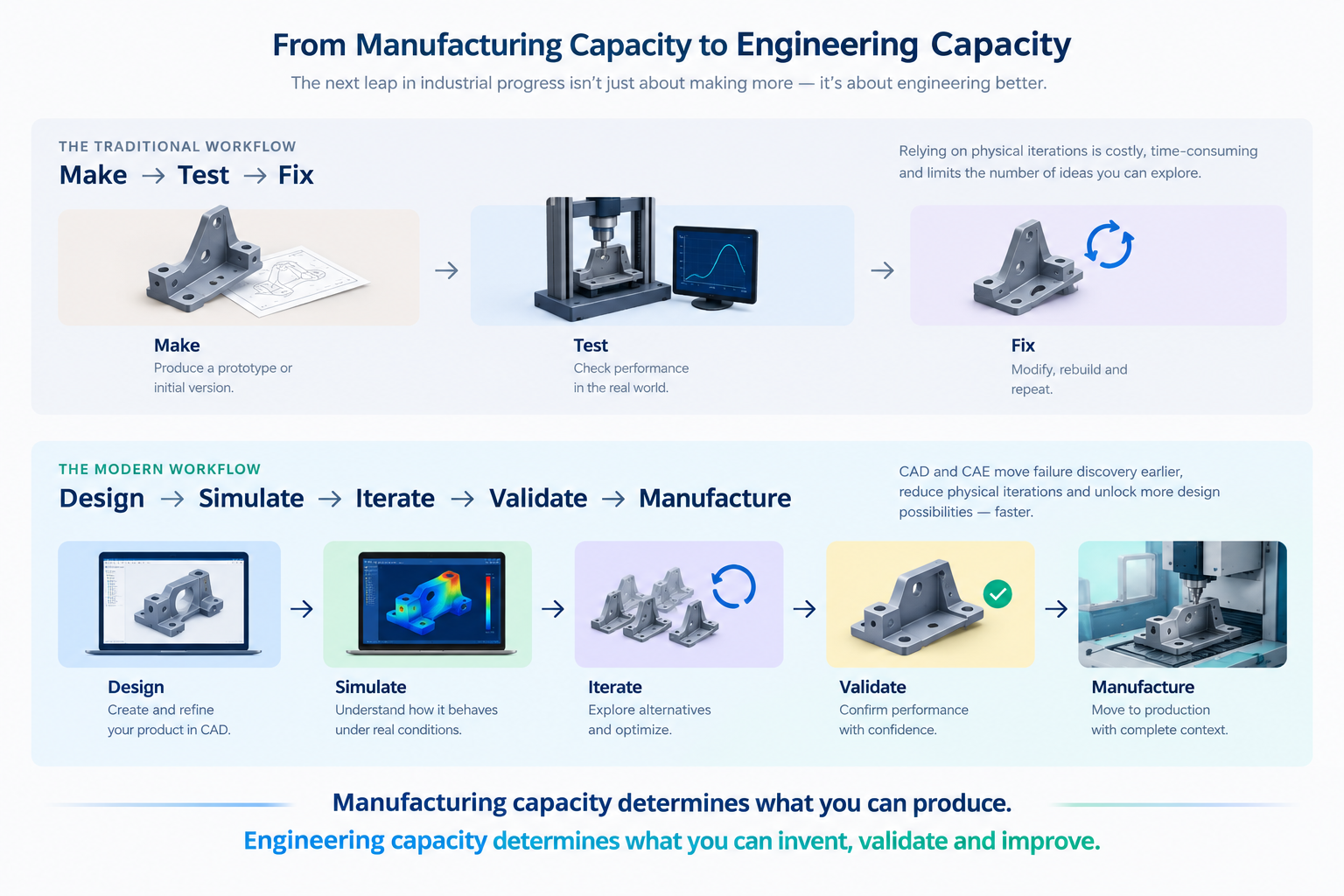
Manufacturing is becoming increasingly distributed.
A sophisticated machine shop can exist far from a traditional industrial center. A small engineering company can manufacture components for global customers. Hardware startups can develop products with relatively small teams. Fabrication businesses can move from producing individual parts to building complete products.
The ability to manufacture is no longer concentrated exclusively within the largest industrial organizations.
But manufacturing capability is only one part of industrial capability.
The ability to design, analyze, validate, and continuously improve physical products is equally important.
This is where CAD and CAE become fundamental.
They are not simply tools used by engineers at the beginning of a product lifecycle. Together, they form an increasingly important computational layer between an engineering idea and the physical product.
The next phase of manufacturing will therefore not only be about expanding manufacturing capacity.
It will be about expanding engineering capacity.
Manufacturing Something Is Different from Engineering It
A physical product can often be manufactured using drawings, measurements, existing samples, manufacturing experience, and iterative adjustments.
For many applications, this works.
A component can be produced, tested, modified, and produced again.
But every physical iteration has a cost.
Material is consumed. Machine capacity is occupied. Engineers and operators spend time preparing and inspecting parts. Testing requires physical resources. Production schedules are affected.
Most importantly, certain failures are discovered only after something has already been manufactured.
This is where digital engineering changes the process.
Instead of discovering every problem physically, engineers can increasingly investigate the behavior of a product before manufacturing it.
The workflow becomes:
Design → Analyze → Iterate → Validate → Manufacture
rather than relying primarily on:
Manufacture → Test → Discover → Modify → Manufacture again
Physical testing remains essential. Simulation does not replace reality.
Instead, simulation moves a significant portion of engineering investigation earlier in the product lifecycle.
The objective is not to eliminate physical failure.
It is to discover more potential failures before they become expensive physical failures.
CAD Is More Than Digital Drafting
Modern CAD is sometimes described simply as a digital replacement for a drawing board.
That description no longer captures its role.
A parametric CAD model contains geometry, relationships, constraints, dimensions, assemblies, configurations, and engineering intent.
It is a computational representation of the product.
Once that representation exists, it becomes the foundation for many downstream engineering activities.
The same model can support design changes, assemblies, drawings, bills of materials, manufacturing preparation, simulation, documentation, and collaboration.
This makes CAD more than a design application.
It becomes part of the digital representation of the physical product.
And as products become increasingly complex, the quality of this digital representation becomes increasingly important.
CAE Moves Engineering Beyond Geometry
Geometry tells us what a product looks like.
Engineering also needs to understand how that product behaves.
Will a component withstand the expected load?
Where will stress concentrate?
How will temperature propagate through a system?
How will a fluid move through a geometry?
Will components interfere during motion?
Will a design remain within acceptable limits under different operating conditions?
These questions move beyond geometry.
They require computational analysis.
CAE provides this layer of understanding.
When CAD and CAE are closely connected, engineers can move from defining a geometry to evaluating its behavior without treating simulation as an entirely separate activity.
That creates a much tighter engineering loop:
Create → Simulate → Learn → Modify → Simulate again.
The faster and more naturally this loop operates, the more design alternatives an engineering team can investigate before committing to physical production.
The Cost of Engineering Iteration Matters
Engineering productivity is not simply about how quickly an engineer can create a model.
It is also about how quickly an engineering team can move through meaningful iterations.
Consider a component that requires ten physical iterations before reaching an acceptable design.
If several of those iterations can be eliminated through digital analysis, the benefit is not limited to the simulation itself.
The organization saves:
- material
- machine time
- testing time
- engineering hours
- production capacity
- development cycles
More importantly, the engineering team can explore a larger design space.
A faster engineering loop allows engineers to ask more questions.
What if the geometry changes?
What if the material changes?
What if the loading condition changes?
What if the component is made thinner?
What if a different configuration performs better?
Digital engineering makes these questions computationally accessible.
That is where the real value of CAD and CAE lies.
Advanced Engineering Should Become More Pervasive
Historically, sophisticated engineering capabilities have often required significant investment.
Specialized software, high-performance computing, trained engineers, simulation expertise, and complex workflows can create substantial barriers to adoption.
Large industrial organizations can build teams and infrastructure around these requirements.
Smaller engineering organizations often operate under very different constraints.
They may have strong manufacturing expertise but limited simulation resources.
They may have capable engineers but fragmented software workflows.
They may outsource parts of the engineering process because building a complete digital engineering stack internally is difficult.
The result is an important asymmetry:
Manufacturing capability can be widely distributed while advanced engineering capability remains concentrated.
Closing that gap does not mean simplifying engineering or reducing it to a low-cost software product.
It means making sophisticated engineering capabilities more accessible without making them less capable.
The objective should be greater engineering depth, available to a broader manufacturing ecosystem.
From Manufacturing Capacity to Engineering Capacity
This distinction becomes particularly important as manufacturing expands across emerging industrial ecosystems.
The ability to manufacture an existing design is valuable.
The ability to independently design, analyze, optimize, and manufacture new products is more powerful.
The first provides production capacity.
The second creates engineering capacity.
Engineering capacity allows companies to move beyond reproducing existing products and toward developing their own.
It allows manufacturers to solve new problems rather than only execute established processes.
It enables smaller organizations to experiment with products that would previously have required much larger engineering teams.
And it allows physical manufacturing to be supported by a deeper computational understanding of the products being created.
This is why the next generation of manufacturing software cannot be viewed only through the lens of CAD.
The larger opportunity is to strengthen the entire engineering loop.
AI Can Accelerate the Engineering Loop
Artificial intelligence introduces another significant change.
Traditional engineering software provides powerful computational tools, but many workflows still require substantial manual setup, specialized knowledge, and repeated interaction between different systems.
AI can increasingly assist with these processes.
It can help engineers explore design alternatives, automate repetitive operations, accelerate simulation workflows, identify relevant engineering patterns, and interpret large amounts of engineering data.
The long-term opportunity is deeper than adding an AI assistant to existing engineering software.
AI can become part of the computational engineering loop itself.
An engineer defines an objective.
The system generates or modifies a design.
The design is evaluated.
The results inform another iteration.
The process continues until the design converges toward the required engineering objectives and constraints.
This creates the possibility of a much tighter relationship between design and analysis.
Instead of simulation being something performed after a design is substantially complete, computation can increasingly participate in the design process itself.
The Engineering Software Stack Is Converging
For decades, engineering workflows have been divided across specialized systems.
CAD handles geometry.
CAE handles simulation.
CAM handles manufacturing preparation.
PLM handles product information.
Collaboration systems handle communication and versioning.
Each category solves an important problem.
But the physical product does not exist as separate categories.
There is one product.
Its geometry, engineering behavior, manufacturing information, documentation, and revisions are all connected.
The software representing that product should increasingly reflect the same reality.
A modern engineering environment should allow information to move naturally between:
Design → Simulation → Manufacturing → Documentation → Collaboration
without repeatedly breaking the underlying engineering context.
This is not about eliminating specialized engineering capabilities.
It is about connecting them more intelligently.
Engineering Infrastructure for a More Distributed Manufacturing World
As manufacturing becomes more distributed, engineering infrastructure becomes increasingly important.
A company does not become technologically independent merely because it owns machines capable of producing a component.
It also needs the ability to understand what it is producing, why it behaves the way it does, and how to improve it.
That requires computational engineering.
The combination of CAD, CAE, manufacturing data, AI, and collaboration can provide this foundation.
It can allow a smaller engineering team to operate with capabilities that previously required much larger organizations.
It can help manufacturers move from physical trial-and-error toward computational iteration.
And it can make engineering knowledge increasingly reusable, connected, and scalable.
The result is not simply more software adoption.
It is a broader expansion of engineering capability.
Building the Next Generation of Engineering Infrastructure
This is the opportunity we are pursuing at ANIN.
ANIN is building an AI-native, full-stack hardware engineering platform that brings design, simulation, manufacturing information, and collaboration into a unified engineering environment.
The vision is to make sophisticated engineering computation a natural part of product development—from the first geometry through simulation, iteration, documentation, and preparation for manufacturing.
We believe the future of engineering software lies in tighter integration between geometry and physical behavior, between human engineering judgment and computational intelligence, and between digital design and physical manufacturing.
As advanced engineering becomes more pervasive, the distinction between designing a product and understanding that product will continue to narrow.
The engineering environment of the future will not simply describe what a product is.
It will increasingly help engineers understand how it behaves, how it can be improved, and how it can ultimately be built.
Manufacturing capacity determines what a company can produce.
Engineering capacity determines what it can invent, validate, and improve.
The next generation of industrial progress will require both.