PDM vs Real-Time Collaboration: Why Shared Storage Is Killing Your CAD Workflow
Hardware teams don't lose time to bad engineering. They lose time to the gap between where the file is and where the context lives — and those are never the same place.
Why PDM and Shared Storage Aren't the Same as Collaboration
Every hardware team has a shared drive. It starts organised. Someone creates a folder structure: Designs / v1 / v2 / Final / Final_v2 / Final_v2_REVIEWED. For a while it works. Then a supplier asks for the latest assembly. Someone emails the wrong version. A mechanical engineer opens a file, makes changes, saves it without telling anyone, and three people downstream spend the next two days working from a ghost.
This is the core problem with treating shared storage as collaboration. Files can be stored anywhere. Collaboration — the actual transfer of engineering intent — happens somewhere else entirely: in email chains, Slack threads, meeting notes that nobody reads, and the heads of people who happen to be in the right room at the right time.
When those people leave the company, the context leaves with them. The files stay. The understanding doesn't.
How Traditional PDM Fails CAD Teams
CAD Version Control Without Context Is Just File Naming
PDM and PLM systems were built to solve this problem. And they do — partially, for teams with dedicated CAD admins, rigid workflows, and the discipline to check in and check out every file, every time. For most teams, that's not the reality.
In practice, the version control story for most hardware teams looks like this: a file gets emailed. The recipient opens it, makes changes, saves it locally, re-uploads it to the shared drive with a new name, and emails the team. Three people download it. Two of them also make changes. Now there are three slightly different versions of the "same" file, and nobody has a clear record of which changes were accepted, which were rejected, and why.
The design review happens at the end of this process — when all the conflicts have already compounded into a mess that takes longer to untangle than the original design took to create.
Engineering Context Disappears at Every Handoff
When a mechanical engineer updates a tolerance, that change has a reason. Maybe a supplier flagged a manufacturing constraint. Maybe CAE simulation showed a stress concentration. Maybe someone on the manufacturing floor found that the original spec was impossible to hold at volume.
With file-based storage, the change is captured. The reason isn't. Six months later, when a new engineer opens the file and sees the unusual tolerance, there's no way to know whether it was intentional, a mistake, or a workaround for a problem that has since been resolved.
This is how hardware teams end up re-solving the same problems across multiple product generations — because the institutional knowledge that should travel with the design is buried in an email from eighteen months ago that nobody can find.
Review Cycles That Loop Instead of Resolve
The traditional hardware review cycle is a waterfall. The mechanical engineer finishes the design, exports it, uploads it, sends the link. The reviewer downloads it, opens it in whatever CAD tool they have, makes comments in a separate document, emails those comments back. The mechanical engineer applies the changes, re-exports, re-uploads, re-sends.
Each loop takes days. Each loop loses context. By the time a design reaches manufacturing sign-off, it has been through a game of telephone where the original intent has been quietly transformed in ways nobody fully tracked.
Traditional PDM vs collaborative CAD workflow
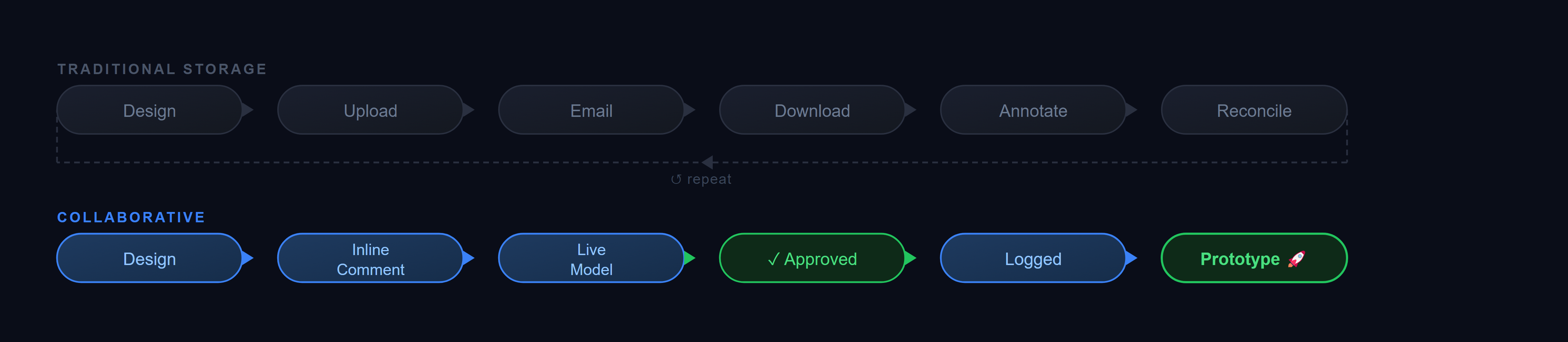
The collaborative path reaches prototype in a single pass. The traditional PDM path loops indefinitely — each repeat cycle is another week of delay and another layer of lost context.
What Cloud CAD Collaboration Actually Means
Real collaboration in hardware engineering isn't about where the file lives. It's about whether the engineering intent travels with the geometry — and whether every stakeholder can see, comment on, and understand a change the moment it happens.
Inline Comments Attached to Geometry, Not Spreadsheets
When an electrical engineer flags a clearance issue, that comment should live on the specific face of the specific component where the problem exists — not in a separate spreadsheet cross-referenced to a line number in a review document. The comment should be visible to anyone who opens the assembly, in context, alongside the geometry it refers to.
This sounds obvious. It is almost never how hardware teams actually work, because traditional CAD and PDM tools separate the model from the discussion by default.
Real-Time CAD Access Without File Handoffs
When the mechanical engineer updates the design, the electrical engineer should see that change immediately — not when the email arrives, not when someone remembers to re-upload the file, but in real time. The model should be the single source of truth, always current, always accessible, without anyone having to manually synchronise anything.
This is table stakes in software development. Every code editor, every digital product design tool, every document editor has solved this problem. CAD and hardware tooling is a decade behind — not because the problem is harder, but because the tools were never built around this expectation.
CAD Version History That Records Decisions, Not Just Timestamps
Every geometry change should capture not just what changed, but why — who made the decision, what the tradeoff was, what alternative was considered and rejected. That context should be searchable, attached permanently to the version, and visible to anyone who inherits the design.
This is what CAD version control actually means in practice. Not a log of file timestamps. A log of engineering decisions — the same way software teams use commit messages and pull requests to make code history readable by anyone, months later.
The Compounding Cost of Coordination Overhead
The frustrating thing about this problem is that each individual failure seems small. A wrong file version costs a few hours. Missing context costs a day. A delayed review cycle costs a week. None of these feels like a crisis in isolation.
But they compound. A hardware team running on traditional file storage and PDM workflows is quietly burning somewhere between 20 and 40 percent of their engineering capacity on coordination overhead — finding the right version, recovering lost context, re-running reviews that should have been resolved in the first pass, and rebuilding understanding that already existed somewhere in the organisation but couldn't be retrieved.
That overhead doesn't show up on a project plan. It shows up as schedule slip, as unexpected rework, as the nagging sense that the team is always almost finished but never quite done. For a hardware startup where runway is finite and every week of delay has a direct cost, that overhead is the difference between shipping and not shipping.
From PDM to Collaborative Engineering: The Tools Are Catching Up
Software development solved this problem twenty years ago. Git gave every change a permanent, contextual record. Pull requests brought review inline with the code. Shared development environments eliminated "it works on my machine" as a category of problem.
Hardware is getting that shift now — through cloud-native CAD platforms built around collaborative engineering from the ground up, not as a bolt-on to existing PDM systems.
Cloud CAD collaboration isn't about moving the file to a server. It's about making the model the collaboration surface itself — where comments, decisions, CAD version history, and live access all exist in the same place, attached to the geometry, accessible to every stakeholder without any manual synchronisation.
When that becomes the baseline, the coordination overhead disappears. The engineering capacity it was consuming comes back. And the team that was always almost done starts actually shipping.
What We're Building at ANIN
At ANIN, this is the problem at the centre of what we're building. The Hardware Engineering OS connects CAD, CAE simulation, and CAM in one workflow — where every change is tracked with full context, every comment lives on the geometry, and every stakeholder sees the current state without a file handoff.
If your hardware team is losing time to version confusion, context that disappears at handoffs, or review cycles that loop instead of resolve — we want to talk.