From Idea to Prototype in Hours: How AI is Giving Hardware Founders Software Velocity
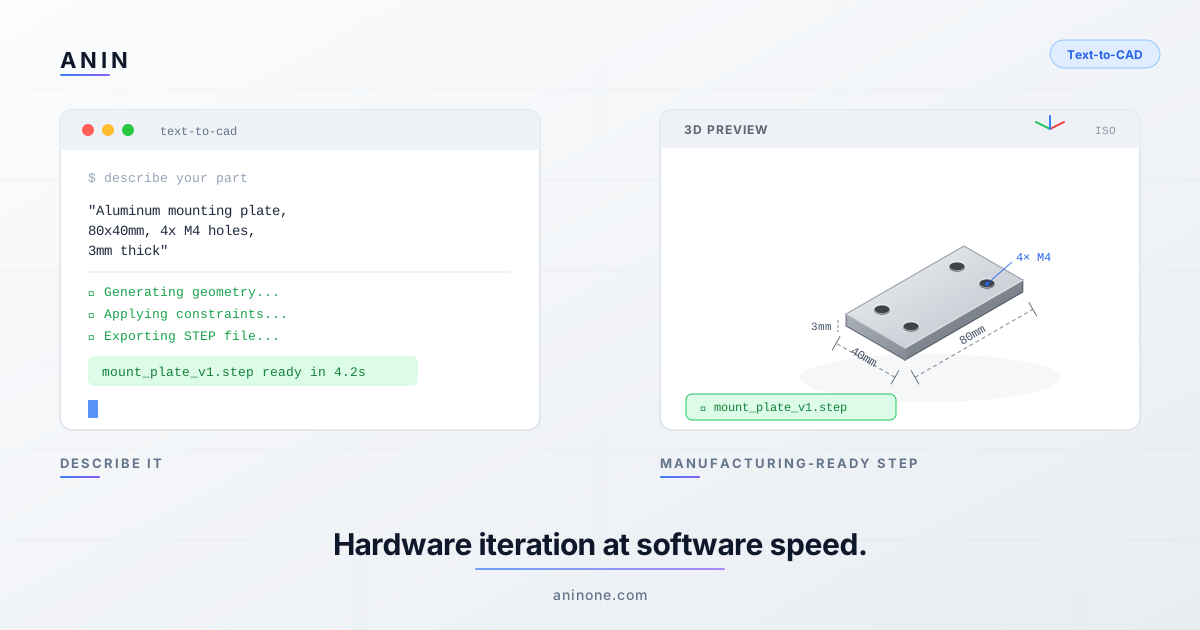
Software startups move at the speed of thought. Hardware startups move at the speed of their tools. For too long, those tools have been the bottleneck. AI is about to change that.
Two Worlds, Two Speeds
If you want to build a software startup today, your iteration cycle is measured in hours. Write code, deploy, get feedback, fix it, ship again. The entire loop from idea to user feedback can happen before lunch.
Now try building a hardware startup. Same ambition, same drive — but suddenly your iteration cycle is measured in weeks. You have an idea, you open your CAD tool, and before you can test anything you're already three days deep in feature trees, constraint errors, and parametric relationships that broke when you changed a single dimension.
It's not that hardware is inherently slower. It's that the tools were built for a world where design velocity didn't matter — where large engineering teams had months to refine a single product before it went to manufacturing. That world still exists inside large corporations. But it has nothing to do with how hobbyists, indie founders, and hardware entrepreneurs need to work today.
How Traditional CAD Slows You Down
Traditional parametric CAD software is an engineering marvel. It can model extraordinarily complex assemblies with precise tolerances and full manufacturing documentation. But the way it works fundamentally conflicts with how fast-moving builders need to think.
In traditional CAD, you don't describe what you want — you construct it procedurally. Every feature is a sequence of operations: sketch a profile, define constraints, extrude, fillet, pattern, mirror. Each step creates a dependency on the steps before it. Change something early in the sequence and everything downstream can break.
This model rewards patience and expertise. It punishes experimentation.
For a hobbyist iterating on a custom robotics component, or a founder trying to validate whether a physical form factor works before committing to a prototype, or an entrepreneur exploring five different design directions in a single day — traditional CAD is fighting against you. Every hour you spend managing the tool is an hour stolen from testing whether your idea actually works.
What AI Changes
AI text-to-design flips the relationship between the builder and the tool. Instead of learning the tool's language, the tool learns yours.
You describe what you want to build. The AI generates a parametric, manufacturing-ready 3D model. You review it, refine the prompt, and iterate — in seconds, not days.
Consider the difference:
Traditional CAD workflow
Idea → Open CAD → Build feature tree → Debug constraints → Rebuild after dimension change → Failed prototype → Start over
AI-native workflow
Idea → Describe it → AI generates STEP file → 3D print & test → Refine prompt → Iterate
Instead of spending three days modeling a component, you simply describe it:
“Design a lightweight aerodynamics-optimized drone arm mount for a 2207 brushless motor, with a hollow channel for internal wiring and a 3-bolt mounting pattern for a 5mm carbon fiber frame.”
The output isn't just a shape — it's geometry that understands 3D printing tolerances, CNC constraints, and material behaviour. Manufacturability is built in from the first prompt, not discovered as a problem at the end.
Software Velocity for the Physical World
Explore More Ideas in Less Time
One of the most underrated advantages software founders have is the ability to explore multiple directions simultaneously. They can spin up three different approaches to a problem, test all of them with real users, and discard two before the week is out.
Hardware founders have traditionally had to pick one direction and commit — because exploring three design directions in traditional CAD takes three weeks, not three hours.
AI text-to-design gives hardware builders the same exploratory freedom. Run five design variants in a morning. Test them in simulation. Send the best two to print. That's software-speed iteration on physical geometry.
Focus on Engineering, Not Tool Operation
The best hardware innovations come from people who deeply understand a problem. A mechanical engineer who has spent years in the field knows exactly what a better component would look like — the physics, the failure modes, the manufacturing constraints. What slows them down is translating that understanding into CAD operations.
AI removes that translation layer. The engineer describes the outcome. The tool handles the construction. The expertise that matters — understanding the problem — stays at the centre of the workflow rather than being buried under tool management.
Instant Manufacturability Feedback
Traditional CAD lets you build almost anything — including things that are impossible to manufacture. You discover that mismatch when a prototype comes back wrong, or when a manufacturer quotes you on a part and flags five issues.
AI-native design understands manufacturing constraints from the start. Every generated geometry respects the rules of the process it's designed for — whether that's FDM 3D printing, CNC milling, or injection moulding. You stop designing things that can't be made, and start shipping things that can.
The Bigger Picture
Software became the engine of the last twenty years of innovation because the tools finally matched the pace at which humans could think and create. Deployment became instant. Iteration became cheap. The gap between idea and reality collapsed.
Hardware development has been waiting for the same shift. The ideas have always been there. The ambition has always been there. The bottleneck was the tools — their complexity, their procedural nature, and the sheer time they demanded before anything useful could come out the other end.
AI text-to-design doesn't replace the engineer. It removes the friction between the engineer and the outcome. And when that friction disappears, the pace of physical innovation can finally catch up to the pace of software.
The hardware founders who move first on this will have an iteration advantage their competitors won't be able to close.
What We're Building
At ANIN, we're building the Hardware Engineering OS around this principle — that design, simulation, and manufacturing should work together as one fluid workflow, not as three separate tools that fight each other.
Text-to-Design is one part of that platform. The goal is simple: give hobbyists, indie founders, and hardware entrepreneurs the same velocity that software builders have had for the last decade.
If you're building in the physical world and want early access, we want to hear from you.